The useful part of Picsart AI is not the word AI on the interface; it is the ability to turn a clear creative decision into a repeatable workflow. For match lighting when backgrounds, that difference matters because small choices in framing, reference quality, motion, or layout change the result quickly.
As of August 2026, the relevant Picsart AI workflow is worth understanding before you copy any resource below. Picsart includes AI Expand for generative uncropping and AI Background tools for creating or replacing backdrops. AI Expand can extend a canvas to ratios such as 16:9 or 9:16 and works best when the source edges give the model clear visual context. That means the strongest instructions are written around what the product actually does today, not around an old menu path or a generic prompt copied from another app.
Below you will find at least 30 practical resources built specifically around match lighting when backgrounds. Some are full copy-paste prompts; others are edit commands, workflow recipes, or settings because that is the more natural way to work inside Picsart AI. The aim is to give you starting points you can adapt, not rigid formulas that force every image or video to look the same.
What a strong result should actually preserve
A strong match lighting when backgrounds output should have a clear purpose before it has a style. Decide whether the priority is identity, visual mood, information, motion, platform fit, or speed. Then give Picsart AI enough context to solve that priority without forcing it to invent unnecessary details. This is especially important when the source contains real people, branded products, recognizable places, or text that must stay accurate.
Use Picsart AI in stages, not all at once
Picsart includes AI Expand for generative uncropping and AI Background tools for creating or replacing backdrops. AI Expand can extend a canvas to ratios such as 16:9 or 9:16 and works best when the source edges give the model clear visual context.
Open the image in Picsart and identify whether the task is background generation, expansion, or another edit.
For AI Expand, create only as much new canvas as the composition needs instead of expanding aggressively in one step.
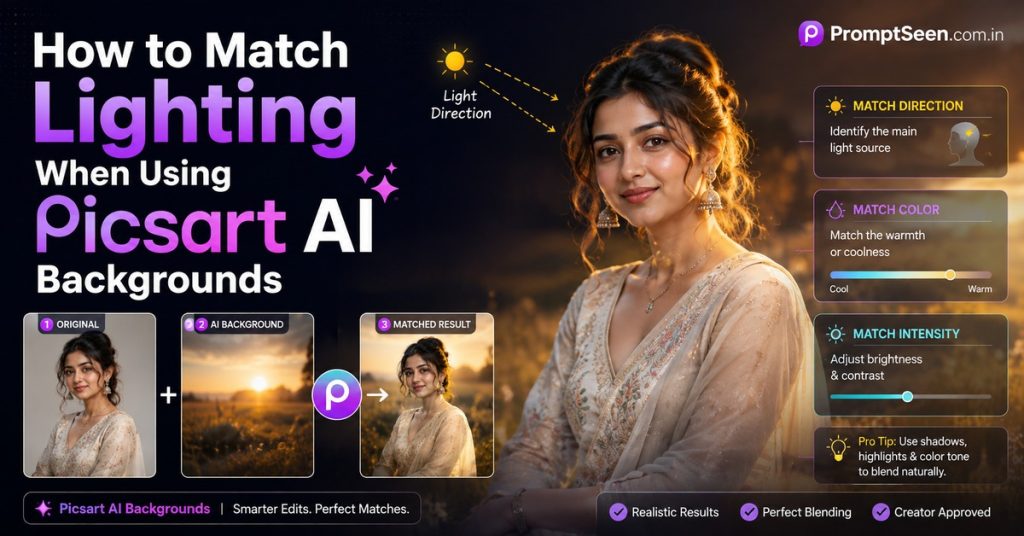
For AI Background, match perspective, horizon height, light direction, and color temperature to the subject.
Inspect hair edges, feet, reflections, and contact shadows after generation.
Apply final color and contrast adjustments so subject and background feel like one photograph.
Use the sequence as a decision framework rather than a fixed ritual. If the source image, script, or footage is already strong, skip unnecessary transformation. The best AI-assisted edit often changes fewer things than the most dramatic edit.
30 practical edit recipes for match lighting when backgrounds
The resources below are deliberately varied. Use them as working material, then customize the subject, platform, visual tone, or constraints to fit your real project.
EDIT RECIPE 01Picsart AI
North-Window Studio
Create or choose a north-window studio background, then match it to the existing subject instead of treating the background as a separate poster. Align the horizon and camera height, match the key-light direction, keep the shadow softness believable, and bring the background color temperature close to the light already falling on the face and clothing. After generation, inspect hair edges, feet, reflections, and contact shadows; use a final color adjustment so the foreground and generated backdrop feel photographed in the same place.
EDIT RECIPE 02Picsart AI
Golden-Hour Exterior
Create or choose a golden-hour exterior background, then match it to the existing subject instead of treating the background as a separate poster. Align the horizon and camera height, match the key-light direction, keep the shadow softness believable, and bring the background color temperature close to the light already falling on the face and clothing. After generation, inspect hair edges, feet, reflections, and contact shadows; use a final color adjustment so the foreground and generated backdrop feel photographed in the same place.
EDIT RECIPE 03Picsart AI
Overcast Street
Create or choose a overcast street background, then match it to the existing subject instead of treating the background as a separate poster. Align the horizon and camera height, match the key-light direction, keep the shadow softness believable, and bring the background color temperature close to the light already falling on the face and clothing. After generation, inspect hair edges, feet, reflections, and contact shadows; use a final color adjustment so the foreground and generated backdrop feel photographed in the same place.
EDIT RECIPE 04Picsart AI
Warm Café Interior
Create or choose a warm café interior background, then match it to the existing subject instead of treating the background as a separate poster. Align the horizon and camera height, match the key-light direction, keep the shadow softness believable, and bring the background color temperature close to the light already falling on the face and clothing. After generation, inspect hair edges, feet, reflections, and contact shadows; use a final color adjustment so the foreground and generated backdrop feel photographed in the same place.
EDIT RECIPE 05Picsart AI
Cool Office Interior
Create or choose a cool office interior background, then match it to the existing subject instead of treating the background as a separate poster. Align the horizon and camera height, match the key-light direction, keep the shadow softness believable, and bring the background color temperature close to the light already falling on the face and clothing. After generation, inspect hair edges, feet, reflections, and contact shadows; use a final color adjustment so the foreground and generated backdrop feel photographed in the same place.
EDIT RECIPE 06Picsart AI
Sunset Rooftop
Create or choose a sunset rooftop background, then match it to the existing subject instead of treating the background as a separate poster. Align the horizon and camera height, match the key-light direction, keep the shadow softness believable, and bring the background color temperature close to the light already falling on the face and clothing. After generation, inspect hair edges, feet, reflections, and contact shadows; use a final color adjustment so the foreground and generated backdrop feel photographed in the same place.
EDIT RECIPE 07Picsart AI
Neon Night Street
Create or choose a neon night street background, then match it to the existing subject instead of treating the background as a separate poster. Align the horizon and camera height, match the key-light direction, keep the shadow softness believable, and bring the background color temperature close to the light already falling on the face and clothing. After generation, inspect hair edges, feet, reflections, and contact shadows; use a final color adjustment so the foreground and generated backdrop feel photographed in the same place.
EDIT RECIPE 08Picsart AI
Beach Midday
Create or choose a beach midday background, then match it to the existing subject instead of treating the background as a separate poster. Align the horizon and camera height, match the key-light direction, keep the shadow softness believable, and bring the background color temperature close to the light already falling on the face and clothing. After generation, inspect hair edges, feet, reflections, and contact shadows; use a final color adjustment so the foreground and generated backdrop feel photographed in the same place.
EDIT RECIPE 09Picsart AI
Forest Shade
Create or choose a forest shade background, then match it to the existing subject instead of treating the background as a separate poster. Align the horizon and camera height, match the key-light direction, keep the shadow softness believable, and bring the background color temperature close to the light already falling on the face and clothing. After generation, inspect hair edges, feet, reflections, and contact shadows; use a final color adjustment so the foreground and generated backdrop feel photographed in the same place.
EDIT RECIPE 10Picsart AI
Hotel Lobby
Create or choose a hotel lobby background, then match it to the existing subject instead of treating the background as a separate poster. Align the horizon and camera height, match the key-light direction, keep the shadow softness believable, and bring the background color temperature close to the light already falling on the face and clothing. After generation, inspect hair edges, feet, reflections, and contact shadows; use a final color adjustment so the foreground and generated backdrop feel photographed in the same place.
Checkpoint after resource 10
Before moving on, compare the latest output with the source and the purpose of the article. For match lighting when backgrounds, the most important question is not whether the result looks dramatic; it is whether the intended subject, message, or motion is still clear. Save the strongest version before trying the next direction.
EDIT RECIPE 11Picsart AI
White Cyclorama
Create or choose a white cyclorama background, then match it to the existing subject instead of treating the background as a separate poster. Align the horizon and camera height, match the key-light direction, keep the shadow softness believable, and bring the background color temperature close to the light already falling on the face and clothing. After generation, inspect hair edges, feet, reflections, and contact shadows; use a final color adjustment so the foreground and generated backdrop feel photographed in the same place.
EDIT RECIPE 12Picsart AI
Dark Charcoal Studio
Create or choose a dark charcoal studio background, then match it to the existing subject instead of treating the background as a separate poster. Align the horizon and camera height, match the key-light direction, keep the shadow softness believable, and bring the background color temperature close to the light already falling on the face and clothing. After generation, inspect hair edges, feet, reflections, and contact shadows; use a final color adjustment so the foreground and generated backdrop feel photographed in the same place.
EDIT RECIPE 13Picsart AI
Brick Alley
Create or choose a brick alley background, then match it to the existing subject instead of treating the background as a separate poster. Align the horizon and camera height, match the key-light direction, keep the shadow softness believable, and bring the background color temperature close to the light already falling on the face and clothing. After generation, inspect hair edges, feet, reflections, and contact shadows; use a final color adjustment so the foreground and generated backdrop feel photographed in the same place.
EDIT RECIPE 14Picsart AI
Festival Light Backdrop
Create or choose a festival light backdrop background, then match it to the existing subject instead of treating the background as a separate poster. Align the horizon and camera height, match the key-light direction, keep the shadow softness believable, and bring the background color temperature close to the light already falling on the face and clothing. After generation, inspect hair edges, feet, reflections, and contact shadows; use a final color adjustment so the foreground and generated backdrop feel photographed in the same place.
EDIT RECIPE 15Picsart AI
Wedding Venue
Create or choose a wedding venue background, then match it to the existing subject instead of treating the background as a separate poster. Align the horizon and camera height, match the key-light direction, keep the shadow softness believable, and bring the background color temperature close to the light already falling on the face and clothing. After generation, inspect hair edges, feet, reflections, and contact shadows; use a final color adjustment so the foreground and generated backdrop feel photographed in the same place.
EDIT RECIPE 16Picsart AI
Modern Kitchen
Create or choose a modern kitchen background, then match it to the existing subject instead of treating the background as a separate poster. Align the horizon and camera height, match the key-light direction, keep the shadow softness believable, and bring the background color temperature close to the light already falling on the face and clothing. After generation, inspect hair edges, feet, reflections, and contact shadows; use a final color adjustment so the foreground and generated backdrop feel photographed in the same place.
EDIT RECIPE 17Picsart AI
Home Workspace
Create or choose a home workspace background, then match it to the existing subject instead of treating the background as a separate poster. Align the horizon and camera height, match the key-light direction, keep the shadow softness believable, and bring the background color temperature close to the light already falling on the face and clothing. After generation, inspect hair edges, feet, reflections, and contact shadows; use a final color adjustment so the foreground and generated backdrop feel photographed in the same place.
EDIT RECIPE 18Picsart AI
Car Showroom
Create or choose a car showroom background, then match it to the existing subject instead of treating the background as a separate poster. Align the horizon and camera height, match the key-light direction, keep the shadow softness believable, and bring the background color temperature close to the light already falling on the face and clothing. After generation, inspect hair edges, feet, reflections, and contact shadows; use a final color adjustment so the foreground and generated backdrop feel photographed in the same place.
EDIT RECIPE 19Picsart AI
Retail Shelf Scene
Create or choose a retail shelf scene background, then match it to the existing subject instead of treating the background as a separate poster. Align the horizon and camera height, match the key-light direction, keep the shadow softness believable, and bring the background color temperature close to the light already falling on the face and clothing. After generation, inspect hair edges, feet, reflections, and contact shadows; use a final color adjustment so the foreground and generated backdrop feel photographed in the same place.
EDIT RECIPE 20Picsart AI
Mountain Overlook
Create or choose a mountain overlook background, then match it to the existing subject instead of treating the background as a separate poster. Align the horizon and camera height, match the key-light direction, keep the shadow softness believable, and bring the background color temperature close to the light already falling on the face and clothing. After generation, inspect hair edges, feet, reflections, and contact shadows; use a final color adjustment so the foreground and generated backdrop feel photographed in the same place.
Checkpoint after resource 20
Before moving on, compare the latest output with the source and the purpose of the article. For match lighting when backgrounds, the most important question is not whether the result looks dramatic; it is whether the intended subject, message, or motion is still clear. Save the strongest version before trying the next direction.
EDIT RECIPE 21Picsart AI
Rainy Road
Create or choose a rainy road background, then match it to the existing subject instead of treating the background as a separate poster. Align the horizon and camera height, match the key-light direction, keep the shadow softness believable, and bring the background color temperature close to the light already falling on the face and clothing. After generation, inspect hair edges, feet, reflections, and contact shadows; use a final color adjustment so the foreground and generated backdrop feel photographed in the same place.
EDIT RECIPE 22Picsart AI
Pastel Wall
Create or choose a pastel wall background, then match it to the existing subject instead of treating the background as a separate poster. Align the horizon and camera height, match the key-light direction, keep the shadow softness believable, and bring the background color temperature close to the light already falling on the face and clothing. After generation, inspect hair edges, feet, reflections, and contact shadows; use a final color adjustment so the foreground and generated backdrop feel photographed in the same place.
EDIT RECIPE 23Picsart AI
Library Interior
Create or choose a library interior background, then match it to the existing subject instead of treating the background as a separate poster. Align the horizon and camera height, match the key-light direction, keep the shadow softness believable, and bring the background color temperature close to the light already falling on the face and clothing. After generation, inspect hair edges, feet, reflections, and contact shadows; use a final color adjustment so the foreground and generated backdrop feel photographed in the same place.
EDIT RECIPE 24Picsart AI
Sports Gym
Create or choose a sports gym background, then match it to the existing subject instead of treating the background as a separate poster. Align the horizon and camera height, match the key-light direction, keep the shadow softness believable, and bring the background color temperature close to the light already falling on the face and clothing. After generation, inspect hair edges, feet, reflections, and contact shadows; use a final color adjustment so the foreground and generated backdrop feel photographed in the same place.
EDIT RECIPE 25Picsart AI
Restaurant Table
Create or choose a restaurant table background, then match it to the existing subject instead of treating the background as a separate poster. Align the horizon and camera height, match the key-light direction, keep the shadow softness believable, and bring the background color temperature close to the light already falling on the face and clothing. After generation, inspect hair edges, feet, reflections, and contact shadows; use a final color adjustment so the foreground and generated backdrop feel photographed in the same place.
EDIT RECIPE 26Picsart AI
Heritage Courtyard
Create or choose a heritage courtyard background, then match it to the existing subject instead of treating the background as a separate poster. Align the horizon and camera height, match the key-light direction, keep the shadow softness believable, and bring the background color temperature close to the light already falling on the face and clothing. After generation, inspect hair edges, feet, reflections, and contact shadows; use a final color adjustment so the foreground and generated backdrop feel photographed in the same place.
EDIT RECIPE 27Picsart AI
Minimal Beige Studio
Create or choose a minimal beige studio background, then match it to the existing subject instead of treating the background as a separate poster. Align the horizon and camera height, match the key-light direction, keep the shadow softness believable, and bring the background color temperature close to the light already falling on the face and clothing. After generation, inspect hair edges, feet, reflections, and contact shadows; use a final color adjustment so the foreground and generated backdrop feel photographed in the same place.
EDIT RECIPE 28Picsart AI
Blue-Hour City
Create or choose a blue-hour city background, then match it to the existing subject instead of treating the background as a separate poster. Align the horizon and camera height, match the key-light direction, keep the shadow softness believable, and bring the background color temperature close to the light already falling on the face and clothing. After generation, inspect hair edges, feet, reflections, and contact shadows; use a final color adjustment so the foreground and generated backdrop feel photographed in the same place.
EDIT RECIPE 29Picsart AI
Soft Floral Wall
Create or choose a soft floral wall background, then match it to the existing subject instead of treating the background as a separate poster. Align the horizon and camera height, match the key-light direction, keep the shadow softness believable, and bring the background color temperature close to the light already falling on the face and clothing. After generation, inspect hair edges, feet, reflections, and contact shadows; use a final color adjustment so the foreground and generated backdrop feel photographed in the same place.
EDIT RECIPE 30Picsart AI
Final Color-Match Pass
Create or choose a final color-match pass background, then match it to the existing subject instead of treating the background as a separate poster. Align the horizon and camera height, match the key-light direction, keep the shadow softness believable, and bring the background color temperature close to the light already falling on the face and clothing. After generation, inspect hair edges, feet, reflections, and contact shadows; use a final color adjustment so the foreground and generated backdrop feel photographed in the same place.
Refine one variable at a time in Picsart AI
The quickest way to make these resources feel less generic is to change one visual variable at a time. For match lighting when backgrounds, useful variables include subject position, lighting direction, background depth, color temperature, crop, camera distance, text-safe space, motion intensity, and the amount of detail you ask the model to invent. Changing five variables at once makes it harder to see which instruction improved the result and which one caused drift.
Keep the vocabulary tied to Picsart AI. Terms such as Picsart, AI Expand, AI Background, generative uncrop, background replacement are more useful here than importing a workflow from a completely different product. The goal is not to stuff these entities into the text; it is to use the language that accurately describes what you are controlling.
For social publishing, decide the destination before the final generation. A vertical 9:16 frame gives a different amount of breathing room than a square 1:1 post, while banners and thumbnails need intentional text-safe areas. If the subject is a person, make sure the crop still works on a phone screen. If the asset is a design, zoom out and check whether the hierarchy remains obvious when the post is viewed small.
When match lighting when backgrounds goes wrong
AI-assisted creative tools are probabilistic, so the most useful troubleshooting habit is to identify the first visible failure rather than describe the whole result as “bad.” Fix the earliest failure and regenerate from the best prior version.
The face or main subject drifts
Reduce the number of simultaneous transformations. Restate what must remain unchanged, use the clearest reference, and make the next edit smaller. In Picsart AI, keep the correction tied to match lighting when backgrounds rather than adding unrelated creative changes at the same time.
The image looks too synthetic
Ask for natural skin texture, believable light falloff, restrained sharpening, realistic materials, and fewer dramatic style adjectives. In Picsart AI, keep the correction tied to match lighting when backgrounds rather than adding unrelated creative changes at the same time.
The background does not match the subject
Correct camera height, light direction, color temperature, depth of field, and contact shadows before changing anything else. In Picsart AI, keep the correction tied to match lighting when backgrounds rather than adding unrelated creative changes at the same time.
The composition feels busy
Remove secondary objects, simplify the background, preserve one focal point, and create intentional negative space. In Picsart AI, keep the correction tied to match lighting when backgrounds rather than adding unrelated creative changes at the same time.
Text or poster hierarchy is weak
Generate the visual asset first when necessary, then finish important typography in a design editor where spacing and alignment are controllable. In Picsart AI, keep the correction tied to match lighting when backgrounds rather than adding unrelated creative changes at the same time.
Video motion warps the image
Lower motion complexity, avoid conflicting camera moves, keep subject action small, and regenerate from a source image with more room around the subject. In Picsart AI, keep the correction tied to match lighting when backgrounds rather than adding unrelated creative changes at the same time.
The result ignores one detail
Move the important constraint earlier in the instruction and isolate it in a short follow-up edit instead of repeating the entire prompt. In Picsart AI, keep the correction tied to match lighting when backgrounds rather than adding unrelated creative changes at the same time.
Practical observations that matter for this workflow
Keep a version that is close
When a result is 80–90% correct, save it before experimenting. Iterative AI tools can drift. Keeping a good checkpoint lets you return to a believable face, strong composition, or clean scene instead of trying to reconstruct it from scratch. For article 23, apply this check specifically to match lighting when backgrounds before you accept the final version.
Reference quality changes what the model can preserve
For match lighting when backgrounds, a clean reference usually gives the system more usable visual information than a heavily filtered screenshot. Faces are easier to preserve when the eyes, jawline, hairline, and lighting are readable. Products and architecture benefit from edges that are not cropped too tightly. Video tools benefit from source images that leave some physical room for motion. For article 23, apply this check specifically to match lighting when backgrounds before you accept the final version.
Specificity works best when it is organized
A useful instruction separates subject, action, environment, camera, light, and constraints instead of stacking adjectives. In Picsart AI, that structure makes revision easier because you can change one part without rewriting the whole creative brief. For article 23, apply this check specifically to match lighting when backgrounds before you accept the final version.
Preserve before you transform
When the source already contains something valuable—facial likeness, product geometry, typography, a real location, or a strong pose—state that preservation goal before asking for a new style. This is especially important for match lighting when backgrounds, where a visually dramatic result is not useful if the key identity or object changes. For article 23, apply this check specifically to match lighting when backgrounds before you accept the final version.
Natural light logic matters
Generated backgrounds and relighting often fail because the subject has one light direction while the new environment suggests another. Look at highlight direction, shadow side, color temperature, and contact shadows. Matching those four clues can make an AI-assisted edit feel much more coherent. For article 23, apply this check specifically to match lighting when backgrounds before you accept the final version.
Platform format should influence composition
A 9:16 Reel or Story needs vertical headroom and safe space around interface overlays. A 1:1 post benefits from centered balance. A 16:9 banner or thumbnail needs room for text and a clear focal point. Do not generate first and crop blindly later if the format is known in advance. For article 23, apply this check specifically to match lighting when backgrounds before you accept the final version.
Iteration beats one oversized prompt
A first pass should solve the main visual direction. A second pass can fix likeness, lighting, or layout. A third can handle a small object or text adjustment. This staged approach is usually easier to control than asking Picsart AI to replace the background, redesign clothing, change pose, add text, change lighting, and restyle the image in a single instruction. For article 23, apply this check specifically to match lighting when backgrounds before you accept the final version.
Check the boring details before publishing
Zoom in on hands, jewelry, glasses, hair edges, small text, repeated objects, reflections, and background geometry. These details are easy to ignore when the overall match lighting when backgrounds concept looks impressive, but they are often what makes the finished asset look unfinished. For article 23, apply this check specifically to match lighting when backgrounds before you accept the final version.
Related promptseen.com.in/ guides
These first-batch articles connect directly with the same editing or publishing workflow:
What is the best way to start match lighting when backgrounds in Picsart AI?
Start with the cleanest source material and one clear outcome. Use the product’s current workflow, make the first instruction specific but not overloaded, then refine the result in smaller passes.
Do I need a long prompt for match lighting when backgrounds?
Not necessarily. Long prompts help when several visual constraints matter, but short instructions are often better for a precise edit. The useful level of detail is the minimum that makes the creative decision unambiguous.
How can I keep the result looking natural?
Use believable light, realistic materials and skin texture, correct perspective, and modest editing strength. Check hands, edges, reflections, repeated objects, and facial proportions before publishing.
What aspect ratio should I use?
Use the destination as the deciding factor. Vertical 9:16 suits Reels and Stories, 1:1 is useful for square posts, 4:5 gives more portrait space in feeds, and 16:9 works well for wide banners and many video contexts.
Can I reuse these resources exactly as written?
Yes as a starting point, but they work better when you replace generic details with your real subject, setting, brand, clothing, platform, and creative goal.
Why does Picsart AI sometimes change details I wanted to keep?
Generative systems may reinterpret parts of the source while satisfying a new request. State the protected details clearly, make smaller edits, and use the closest successful version as the base for the next step.
Should I make all changes in one generation?
Usually no. Separate major creative direction from small corrections. A staged workflow makes it easier to preserve identity, composition, or timing while fixing one problem at a time.
How do I know when the result is ready to publish?
Check the asset at full size and at phone-thumbnail size. Look for anatomy, text, edges, light consistency, crop safety, and whether the main message is understandable immediately.
Are these instructions tied specifically to Picsart AI?
Yes. The resources are written around Picsart AI and its current use cases rather than being copied from another AI tool and renamed.
Where should I verify feature availability?
Use the official Picsart AI product or help documentation because AI features, plans, devices, and regional availability can change. The official reference used for this article is https://support.picsart.com/hc/en-us/articles/35592187399325-How-to-use-AI-Expand-in-Picsart.
Final takeaway
Use this Picsart AI guide as a practical starting point for match lighting when backgrounds, not as a reason to make every result identical. The strongest workflow is usually the one that protects what already works, changes only what serves the creative goal, and leaves enough room for a final human review. Keep the best intermediate version, verify the current app interface if a menu or plan has changed, and treat each generation as material to edit rather than an unquestionable final answer.
A practical Google Gemini guide to gemini black-and-white portrait prompts classic photography, with 30 app-specific resources, current workflow notes, customization ideas, troubleshooting, and natural examples for creators.
A practical ChatGPT guide to whatsapp dp prompts creative profile photos, with 30 app-specific resources, current workflow notes, customization ideas, troubleshooting, and natural examples for creators.
A practical PixVerse AI guide to turn photo into viral effect, with 30 app-specific resources, current workflow notes, customization ideas, troubleshooting, and natural examples for creators.
A practical Filmora AI guide to tools faster video editing, with 30 app-specific resources, current workflow notes, customization ideas, troubleshooting, and natural examples for creators.
A practical ChatGPT guide to saree photo prompts elegant indian portraits, with 30 app-specific resources, current workflow notes, customization ideas, troubleshooting, and natural examples for creators.
A practical Meta AI guide to festival image prompts indian social media creators, with 30 app-specific resources, current workflow notes, customization ideas, troubleshooting, and natural examples for creators.